Wednesday, October 20, 2021

Day Trip 2021: Mono Cliffs Provincial Park - Hockley - Beeton


Having visited Goodwood, Ontario to see three major exterior locations for the comedy Schitt’s Creek, our “fandom tour” would not be complete without seeking out the site used to represent the Rosebud Motel, which was located near Mono, Ontario.  Pairing this with a hike through Mono Cliffs Provincial Park with a stop on the way home at the Hockley General Store in Hockley Valley, we had the makings of another fun, single-day road trip.  As always happens on our driving adventures, we usually stumble upon unexpected stops along the way.  On this trip, we spotted a cool antique shop in the middle of nowhere while driving along Mono Centre Road/Dufferin County Road 8, and stopped in the small community of Beeton, Ontario to get a closer look at the interesting architecture found there.

The Rosebud Motel that Johnny, Moira, David and Alexis Rose reluctantly moved into, in the fictitious town of Schitt’s Creek, is actually the Hockley Motel found on Hockley Road just east of Mono, Ontario.  After the end of the series in 2020, the sign from the show is gone and the motel is actually up for sale.  A long metal chain blocks the entrance to the driveway to prevent cars from approaching, and a “Beware of Dog” sign attempts to keep foot traffic away.  It will be interesting to see what happens to this motel and whether whoever buys it will try to cash in on its former claim to fame.

Mono Cliffs Provincial Park 
spans 1810 acres and is located just north of the township of Mono.  It is part of both the Bruce Trail and the Niagara Escarpment.  There are multiple loop trails to choose from, giving you varied terrain including cliff faces, interesting rock formations, vast expanses of forests, and several lakes and ponds.  You can buy a half day or full day pass to visit the park, although it was unclear if anyone is actually checking during the pandemic.  We bought a full-day pass and arrived early, hoping to spend a good part of the day here.  Unfortunately it started to rain just before noon, so we cut out some of the loops that we were hoping to explore and will need to come back another day.  We ended up traversing sections of the Carriage Trail, Spillway Trail, Cliff-Top Side Trail and Walter Tolver Trail.  On our next visit, we would like to check out McCarston’s Lake Trail, the Lookout Trail and the South Outlier Trail.

We probably missed the height of the fall colours by a week or so, since many of the leaves had already fallen, creating an orange and gold blanket under the trees.  The views were quite varied but all beautiful as we hiked from trail to trail.  We love how peaceful and serene it is to visit conservation areas mid-week when we are often the only people on the trails, especially when we get an early start.  Walking on the Carriage and Spillway Trails, we passed by several bodies of water as well different types of trees and a variety of foliage.

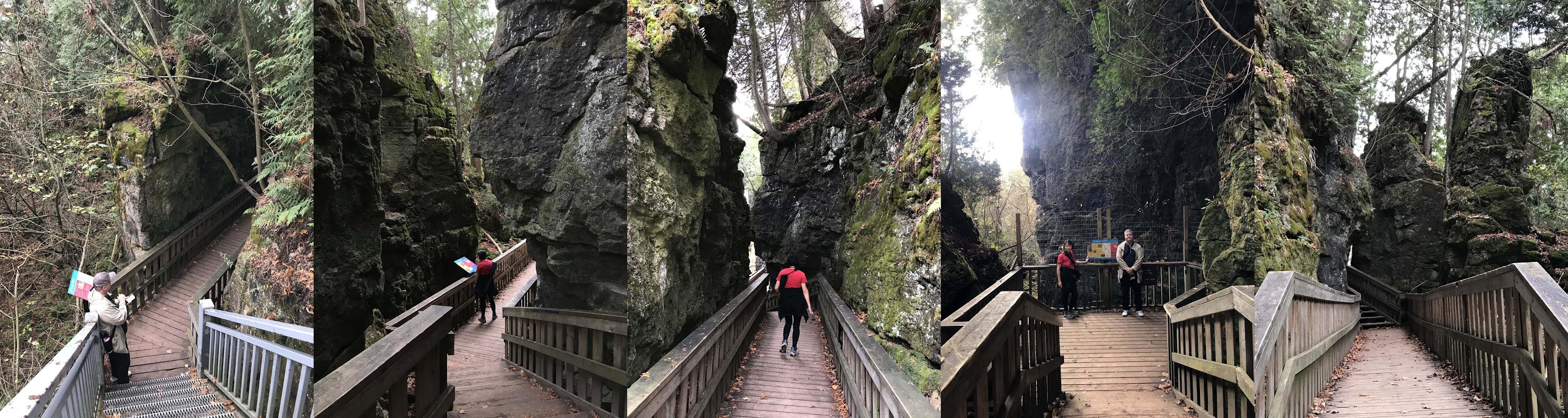
As we were nearing the viewing platform at the top of the Cliff-Top Side Trail, we were on the lookout for a set of stairs which, based on our research, would lead down to an area often referred to as “Jacob’s Ladder”.  After descending the steep metal stairs, you come to a cavernous pathway cut through a canyon with looming 30m high cliffs on both sides.  The  jaunt along a wooden boardwalk was short, but the experience was eerie and magical.

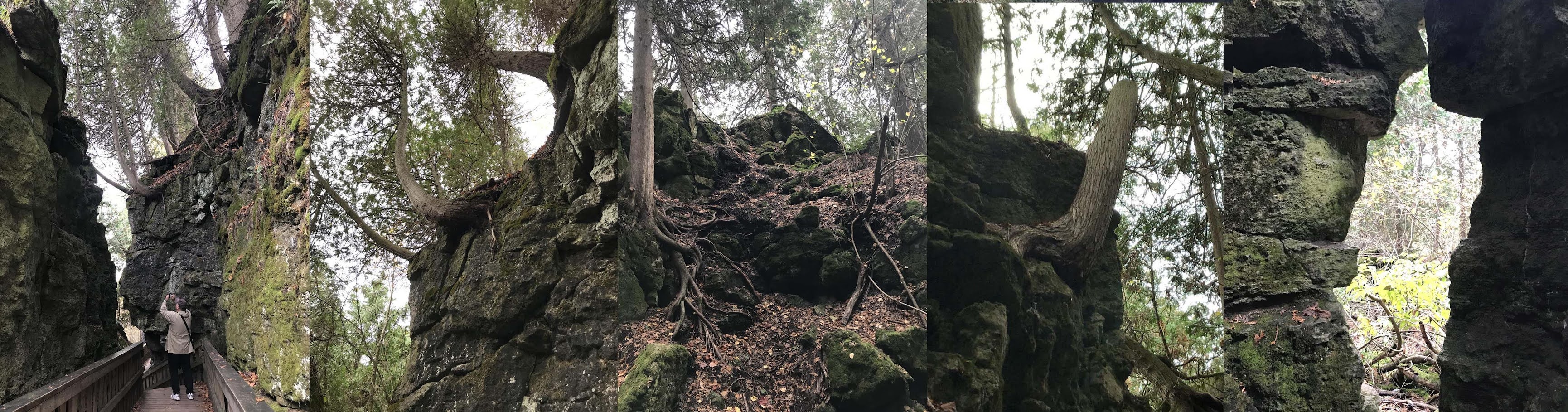
Some of the rock formations were covered with moss and others have cedar trees growing out of the stone surfaces. Many of the small, gnarly cedars growing out of the cracks and crevices of the rocks are hundreds of years old, with the oldest one being over 1500 years old.  In some cases you can see the sprawling roots growing on top of the rocks.  Occasionally the rock formations come together in such a way that a “window” is formed exposing the woodlands that lie in the distance.

Ascending back up the stairs and continuing on the Clifftop Side Trail, we soon arrived at the Viewing Platform which gave us a great view of the forest below.  Again, it was too bad that we missed the peak of the fall colours, and that the lack of sunshine meant the remaining the hues appeared a bit dull.  But the mere expanse of all the trees and the pretty pond below was still breath-taking and we could imagine how stunning the sight would be on a bright day at the height of the autumn leaves season.

As the clouds continued to darken and we experienced an intermittent drizzle of rain, we headed back towards our car, but decided to descend another set of steep stairs in order to walk a portion of Walter Tovell Trail before calling it quits.  This led us through a beautiful forest of tall, thin, tightly planted birch and fern(?) trees.  Walking along the base of the park allowed us to look back up on the eponymous “Mono Cliffs”.  We could see white rock faces streaked by a scaly covering of yellow lichen.  When we reached a clearing, we looked up in the sky and saw a flock of four to six hawks swooping around.  We reached the parking lot just after noon, and just as it started to rain much harder.  While the lot was relatively empty with only a couple of cars when we arrived in the morning, it was now packed.  I felt sorry for the people unloading their bicycles who had bought the half day pass for the second part of the day, and now it was raining.  I guess the hard-core mountain bikers won’t care.

Upon leaving Mono Cliffs Provincial Park, we headed south along the relatively isolated Mono Centre Road towards Hockley.  Suddenly out of the blue, I spotted a sign advertising antiques, lemonade, pumpkin muffins and short bread. Built on the property of a rural home, Antiques and Other Stuff is a cute little antique shop that features a floor-to-ceiling stained glass window and a wrought-iron spiral staircase. Speaking to the owner, we found out that she and her husband purchased the window from a Catholic Church in Brooklyn and it was so large that they needed to build a new structure to house it!  The shop is full of knickknacks and antiques for sale, and the grounds have cute garden signs and sculptures which are also for sale.  In addition to picking up a couple of muffins and cookies, we bought a pretty faux-vintage mismatched blue tea cup and saucer to add to our collection at home.  It was cash only and we only had limited cash with us, or I would have taken a closer look at the garden sculptures.

Continuing along the roads to Hockley, we drove some scenic and quite exhilarating stretches of steep and windy roads that felt like a twisty roller coaster.  At one point we passed by the entrance to the Hockley Valley Glen Cross Side Trail, which has another 4km of hiking trails through the woods and is part of the Bruce Trail.  We made note of this as somewhere we could explore in the future.

Reaching our destination of the Hockley General Store, we were hoping to have some lunch before heading home.  Serving the Hockley Valley Area, this is an all-encompassing store offering fresh, local and organic produce and other groceries, packaged goods, LCBO & Beer outlet, coffee shop, bakery, frozen prepared meals, as well as a food counter where you could order breakfast or lunch meals.  The General Store has a rustic feel, guarded in front by the “Hockley Horse”, the store mascot which is painted with scenes of equestrians on one side and the Canadian Flag on the other.  Scattered around the storefront are pumpkins and some squashes of such weird shapes that they looked like works of art.

Inside, we admired the surprisingly good selection of alcohol as well as what would be considered “fine foods” with brands that you would find in higher-end grocery stores.  For lunch, I ordered a roast beef panini with caramelized onions, swiss cheese and house-made horseradish mayo, while Rich got the Hockley Hero sandwich—a grilled baguette with ham, turkey, Italian sausage, cheddar, swiss cheese and house-made mustard.  We shared a butter tart and a  Bull's Head ginger beer, a brand that we were not familiar with but was quite good.

Across from Hockley General Store is a pretty house with a large wrap-around front porch and elements of the Carpenter Gothic style, with the small steeped pitched portion of the roof embellished with a decorative trim and a window underneath.  There is a historic plaque in front that indicates this building used to be the old Post Office from 1863-1918 and describes the contributions of Thomas Hockley, who the area was named for.  The house next door has a quirky sculpture of cowboy riding a horse rodeo-style.

On the way home from Hockley Valley, we drove through the town of Beeton, Ontario. We were impressed with the cool architecture that we saw there, so we decided to stop and look around.  We learned that the town was renamed from Clarksville to Beeton, in honour of David Allanson Jones, a renowned local apiarist who raised bees, ran the company Jones Perfection Bee Hive, was editor for the Canadian edition of “The Bee Journal” and was postmaster for the town.  The tomb for D.A.Jones was the largest in St. Andrews Presbyterian Cemetery, whose land he donated.  The local public library is also named the D.A.Jones Branch.  The historic building currently housing the IDA Pharmacy and Bee Town Medical Centre dates back to 1894 and was once a printing press.

We liked the unique circular shape of the St. Andrews Presbyterian Church, which is directly across the street from the cemetery, also on land donated by D.A. Jones.  Built in 1890 on a foundation of stones, the church has 40-foot ceilings, a sloping floor and was originally heated with a wood stove in the basement where services were held in the winter so that the congregation could keep warm.  At 148 Main Street West, just a couple of buildings west of St. Andrews Church, there seems to be yet another church, but on closer look, it became apparent that this gorgeous church-like building with large stained glass windows and a tower,  is actually a private home with a pool in the backyard. I could not find reference to whether this ever used to be a church, but it certainly looks like one. There  were many other beautiful homes on Main Street and I would love to return some day to take a closer look at them.

Quaint shops and eateries can be found further east on the historic Main Street. 
There is the Lickity Split ice cream parlour with 24 flavours of soft ice cream (unfortunately closed for the season), and couple of “punny” establishments including the massage therapy centre called "Nice to be Kneaded”, and the “Bee Sew Busy” gift and crafts shop.  In another bee reference, the local antique shop is called “The Village Bee”.  Across the road can be found the Muddy Water Hotel Restaurant and Bar, serving beer and chicken wings, burgers and other fare, with live music acts or a DJ playing music, a dance floor, big screen TV, pool tables and two patios.  Despite the name, there is no indication of this being a hotel.  But the building dates back to circa 1885 and there is a sign advertising “Miss Edgar’s Muddy Water Hotel and Home for Wayward Girls”.   I’m not sure what this refers to as the only mention of this that I could find on the internet was a country song by Harlan Wells called “Miss Edgar’s Muddy Water Tavern” which includes "wayward girls" in its lyrics.  It is not clear whether this building inspired the song or the song inspired the sign on the building?

Thursday, October 14, 2021

Scarborough Bluffs: 2021

 After living in Toronto for most of our lives, it took a pandemic and not being able to travel abroad to spur my husband Rich and I into visiting the beautiful Scarborough Bluffs, Bluffer’s Park and Marina.  Prior to this and for no particular reason, the furthest east we had been  along the Toronto waterfront was to the R.C. Harris Filtration Plant.  After walking ad infinitum around a 6-7km radius around our home at the beginning of the pandemic, we finally started to explore further afield.  Within a span of seven months in 2021, we ended up making 3 excursions east of the filtration plant, each time getting closer and closer to Scarborough Bluffs.  In a weird way, we were taking mini “vacations” within our own city.

For our first trip in April, we decided to park just east of the Toronto Hunt Club, a private golf course that monopolizes part of the shoreline of Lake Ontario so that the only way to get further east would be to walk on Kingston Road.  Instead we started on Crescentwood Road at the base of Warden Avenue and tried to stay as close to the water as possible.

Our initial glimpse of the water was at Crescentwood Park, although it was quite foggy in the morning.  By the time we passed again on our way back to the car, we had a clear view of Lake Ontario.  Continuing on, we weaved through quiet residential streets where houses sat on big lots that had eclectic and sometimes whimsical garden sculptures on them.  Passing through Harrison Properties, a 2.9 hectare, forested park overlooking Lake Ontario, we reached Rosetta McClain Gardens.

Rosetta McClain Gardens was named after Rosetta West who originally lived on the property with her husband Robert McClain.  In 1959, nineteen years after Rosetta’s death,  Robert donated the land to the city in order to create a large floral park in her honour.  Situated on top of, and currently considered part of the Scarborough Bluffs, the park consists of walking trails through multiple landscaped gardens including rose gardens (befitting of a patron named Rosetta), and a rock fountain surrounded by a pergola.  Given that it was April on our first visit, very few flowers were in bloom yet, but we saw the rose bushes and could image the potential for later in the season.  Due to the lack of flowers, in my mind, I kept hearing the 1967 tune sang by Lynn Anderson with the lyrics “I beg your pardon, I never promised you a rose garden”.  We did see a few daffodils and a small tree blooming with white flowers that Google Lens Search tells me are star magnolias, native to Japan.

Just east of the gardens, we arrived at Scarborough Heights Park where there is a free parking lot which we made note of for our next visit, an off-leash dog park and a large community garden on the west side of the park.  Next to the garden, off Fishleigh Drive, we found the steep path leading down to the Waterfront walking trails that would take us along the shoreline by the lake at the base of the park.

The trail was a mixture of loose gravel and small stones with large slabs of stone creating man-made “piers” that allowed you to walk out on top of Lake Ontario.  From there we could barely glimpse the Bluffs in the distance.  At this point we were not sure how far this trail would go and we had already walked over 4km to get here.  Needing to retrace the same distance as well as climb the steep hill that we initially came down, we decided that we would call it a day and get closer to the Bluffs on our next visit.  Back at the top of Scarborough Heights Park, we did venture near the southern edge to peek back down at the shoreline and the lake.  But the sign with the big red letters indicating “Danger Steep Slope” and the image of the figure rolling down the cliffs, (as well as common sense and Rich's unnecessary warning) prevented me from getting too close!

We returned to the Scarborough Bluffs area in mid May with a group of friends, but this time we parked our car at the Scarborough Heights Park so that we could explore the rest of the Waterfront trail.  Descending the steep hill once again and walking past the portions of the trail that we saw last time, we came across a long stretch of large slabs of flat rock, forming both a break-wall and a pathway that led us right to the base of the Bluffs.  Looking up at the majestic cliffs that formed an almost vertical drop, we could truly appreciate the danger signs located at the top of the park, and wondered why people would regularly attempt to climb down these slopes, getting stuck and requiring rescue from the fire department.

We walked along the stone break-wall and continued on the Waterfront trail as far as we could, until there was no way to safely continue.  We could see that the Bluffs went on further and at the other end, way off in the distance, there was a beach.  This would be as far east as we would get on this visit but there was obviously more to see!  Returning on the path, we continued a bit further west of our steep entry point.  After trudging through a bit of brush and climbing over a few boulders, we came across another rocky beach where some of the larger boulders were covered with graffiti.  

After the walk along the Scarborough Heights Park trails, we returned to Rosetta McClain Gardens for another look.  It was still too early in the season for roses but tulips were in full bloom.  There were pink, fuchsia and yellow “Double” tulips, which have more petals than the regular cup-shaped ones.  Off in a corner, there was also a bed of daffodils that were a pretty mixture of yellow and white. We spotted many interesting shrubs and trees including one with curved trunks that formed a perfect seating area, and the Weeping Cherry tree, a combination of two of my favourite trees—the Weeping Willow and the Cherry Blossom.

We came across the brick walls and a metal gate that are the remnants of the old McClain homestead.  There is a map of the Rosetta McClain Gardens that show many more paths that we have not yet explored.  We still need to come back here in late June/early July so that we can actually see roses.

Rich and I returned a third time to the Scarborough Bluffs area on a sunny, unusually warm day in mid October.  This time we started at Bluffers Park, even further east than the previous two trips.  To our dismay, when we headed for the Bluffers Park Lookout Point where there is also a heritage plaque, we found that a major portion of the park (the South Headland) was closed for construction in order to firm up “shoreline erosion and sediment control structures”.  Luckily, there were still many other beautiful sections of the park that we could access, but it seems like we will need to return for yet another visit once all the construction is done.  The Toronto Conservation Authority website indicates that the fences may come down by end of June 2022.  This would align with when we want to re-visit Rosetta McClain gardens and hopefully finally see the roses in full bloom.

We headed first toward the small, unnamed western beach just north of the lookout point.  To get there, we walked through some bushland, crossed a bridge and passed a marshy area covered with lily pads, spotting the peaks of the bluffs in the distance.  At one point we saw a sign warning “DO NOT CLIMB THE CLIFFS” and once again, I thought “No kidding!”. Finally reaching the beach, we were right at the base of the cliffs.  As this was a Wednesday morning, there was no one else in sight as we had the whole beach to ourselves.  

Next we headed to the Bluffers Park Marina where there are several yacht clubs as well as a private tight-knit community of 24 house boats lining the pier off of Bluffers Park Road.  Many of the house boats have 3 storeys with both upper and lower outdoor decks facing the water.  We checked out a few that were on the market and they were nicely furnished year-round homes with modern kitchens and bathrooms, 1-2 bedrooms, selling for between $420,000-$840,000.  This might be an interesting alternative to the Muskoka cottage, if you don’t mind that your home bobs up and down.

Continuing on, we finally reached the Bluffers Park Beach.  This one is a much larger beach than the first one we saw earlier in the day, as the sands stretched as far as the eye can see.  From this beach, we caught more views of the Scarborough Bluff cliffs, but with different trees that showed some signs of their autumn leaves changing colours.  It was too cold for swimming at this point, but apparently in the summer, you would find many people in the water.  We only saw a few people strolling along the sandy shore, and a man sitting on a lawn chair at the edge 
of the water, staring out at the Lake while his female companion lay on the sand soaking up some rays.  It made for a very serene scene.

Although we were quite tired at this point, we decided to explore the last long stretch of land that extended out from the west end of Bluffer’s Park Beach.  From there, we spotted boats docked at the Cathedral Park Yacht Club, could barely see the top of house boats way off in the distance, and enjoyed nice scenic views of the shoreline.  By the time we walked back to the car, we had covered over 8km and earned the pumpkin-flavoured ice cream that we stopped at Ed’s Real Scoop for before heading home.

After 3 consecutive trips to the Scarborough Bluffs area between the spring to fall of 2021, we are now close to saying that we have thoroughly explored this area.  The Bluffs have been truly a magnificent sight that we have admired from all angles and vantage points. It’s too bad that it has taken us so long to appreciate the beauty found in our own “backyard”.

Thursday, September 30, 2021

Day Trip 2021: Goodwood, Durham Forest, Uxbridge Day Trip

In planning a day trip around a hike in the Durham Regional Forest, we scheduled a stop at nearby Goodwood, Ontario, followed by the hike, then lunch at Slabtown Cider Company and finally a visit to the town of Uxbridge.  Accompanied by our friends Yim and Murray, we set off on another road trip adventure, which has become an almost weekly to bi-weekly occurrence for my husband Rich and I, to make up for the fact that we had not traveled abroad for over 2 years due to the ongoing pandemic.

Prior to the arrival of the hit Canadian comedy Schitt’s Creek, there was not much reason to stop at Goodwood Ontario, which is an offshoot of the township of Uxbridge.  All that changed when this TV show selected three buildings on adjacent corners of the intersection of Hwy 47 and Concession Rd. 3 to use as exteriors for locations featured on the show.  The faded blue warehouse representing “Bob’s Garage” is the warehouse of Goodwood handyman Joe Toby who makes special equipment for families with disabled kids. The frontage of “Café Tropical”, where Twyla served meals to Johnny and Moira Rose, is actually a private residence.  The building presented as the exterior for David and Patrick’s business “Rose Apothecary” was once Goodwood’s General Store.  It now has a sign on it for a Romni Wools store but this location seems to be permanently closed.  Crowds flocked to view these sites, especially after the show was picked up by Netflix and then swept the Emmy Awards in 2020.  The hubbub seems to have died down since, so visiting on a Thursday morning, we more or less had the block to ourselves.

We did stop by the fourth corner of the intersection where Annina’s Bakery catered food to the Schitt’s Creek cast and crew during their shoots.  The Bakery was quite busy with an unending lineup for their sandwiches and baked goods.  Apparently this has been the case ever since Annie Murphy, who played Alexis Rose, raved about Annina’s butter tarts on Late Night With Seth Meyers.  We had a quick breakfast at the bakery (not needing to wait in line for sit-down service) and sampled the butter tart (just OK) as well as some breakfast sandwiches and sausage rolls.  After breakfast, we found one last Schitt’s Creek set location around the corner.  The 145-year-old yellow-bricked building used as the “Town Hall” in the show was actually Goodwood’s Town Hall until it was sold and now has been converted to a private residence, with a chained fence blocking the front yard and a sign declaring “private property”.  The owner of the house sat in a chair on the front stoop, seemingly ready to defend his home from gawking interlopers.  We respectfully kept our distance but snuck a photo from afar.

After breakfast, we proceeded to the Durham Regional Forest to do some hiking.  Unlike many of the rail trails that we have hiked on (Caledon, Paris, etc.), the trails in the Durham Forest consist of loops of varying lengths and difficulties.  This was much nicer since we did not need to double back and retrace our steps to get back to our starting point, and we could veer off from the main trails onto smaller offshoots that had different terrains and views.  We intended to hike the 3.2km White Pine Trail Loop but along the way, we might have accidentally strayed onto parts of the Spruce, Maple or Red Oak Trails which crossed and ran parallel to the White Pine loop.  Then a couple of times, we intentionally took some smaller loops that ended back onto the Pine loop after a quick detour.

Durham Regional Forest has pretty forested trails that range from relatively flat level paths for casual walking to sloped and bumpy terrain to please the mountain bikers.  The main trails such as the White Pine Loop seem to be the flat ones while the smaller loops that we tried including “Baby Butter” and “Luce Link“ had more varied terrain.  For fun, Yim and I tried to do some yoga poses on some tree stumps although her knees were much stronger than mine and she nimbly hopped onto a taller stump that I would not have been able to manage.  The best part of the hike was discovering all the different types of wild mushrooms on the trails, which ranged in size, shape and colour and grew both in the ground and on tree trunks.  The trails were so pretty and interesting and there were so many others that we did not have time to explore, so we need to return here another time.

We had made lunch reservations at Slabtown Cider Company, a craft cidery located on Oak Ridges Moraine just south of Uxbridge, specializing in “handcrafted heritage cider crafted from 100% Ontario apples”, as well as ciders blended with other ingredients including cherry, pineapple, mint/lime or blackcurrant.  We had requested an outdoor table under a large covered patio with views of the apple tree orchards.  It turned out to be chillier than expected, so we bundled up and jockeyed for position in order to snag one of the limited propane heaters.  Despite having a later 2pm reservation on a Thursday afternoon, the restaurant was fairly full.

Yim and I shared a cider flight of 4 different ciders.  For my 2 glasses, I selected the black currant and the cherry cider.  Rich ordered a large pumpkin spiced cider.  For our meals, Rich and I shared the Thunder Ridge bison burger topped with crispy pork belly, onion rings, a cider-barbeque sauce and scallion aioli, as well as a prime rib steak pizza with sauteed onions, wild mushrooms, mozzarella, blue cheese and tomato sauce.  For dessert we shared an apple pie topped with pecans while Yim and Murray shared a crème brûlée.  I liked the black currant cider so much that we bought a bottle to bring home.

We finally arrived in the town of Uxbridge just after 4pm with the intent to check out the shops on their main street, followed by a self-guided historic walking tour that I had found on the internet.  To our surprise, most of the stores and eateries on the main drag had closing times of 4pm and were already shut down!  We thought maybe this was because we were there on the National Day of Truth and Reconciliation, our new federal statutory holiday, as was highlighted by orange ribbons tied around the trees.  But when we asked one of the few stores that was still open, we were told that this is the normal closing time.  Instead we started the historic walking tour with one of the highlights, the public library.  Unfortunately we found it covered with scaffolding, covering much of the library’s decorative features.  Given that it was getting later and the weather was continuing to dip on a grim, cloudy day, we decided to cut short the historic walk and just head towards the second highlight of the town, which is the train station.

Along the way, we did find a few points of interest on the main street.  A plaque on the wall in front of one store indicated that this was the location where Canadian artist and painter David Milne had a studio between 1940-47.  Using oils and watercolours, Milne painted Canadian landscapes.  During and following WWI, he acted as a war artist who documented battlefields, ruined cities and soldier camps.  Downtown Uxbridge features two main war memorials.  There is one next to the library that commemorates WWI, WWII and the Korean War.  A more personal memorial across the street pays tribute to Lieutenant Colonel Samuel  Sharpe who suffered from Post Traumatic Stress Disorder (PTSD) and committed suicide following the first world war, haunted by all the men under his command who died.  This sculpture, depicting Sharpe struggling to write a letter to the widow of one of his men, highlights the issues of mental health and PTSD.    We admired the Art Deco design of the Roxy Theatre, with 2 screens showing both first-run and classical movies.  Given its beautiful exterior, it would have been fun to check out the interior and perhaps watch a movie.  Maybe we can do this next time we visit, hopefully on a warm sunny day when we can continue the historic walking tour.

Our final stop in Uxbridge was the train station of the Grand Trunk Railway, built in 1904.  Now considered a heritage site and acting as both a railway museum and a station within the York-Durham Heritage Railway (YDHR), the station was bought by the township of Uxbridge for $1.00 in 1988 and is the only remaining station with a “witch’s hat” roof in Ontario.  The YDHR runs 20km between Uxbridge and Stouffville and hosts themed rides including autumn leaves viewing and high tea in the fall and rides catered towards children in the months leading up to Christmas including “Thomas the Tank Engine”, “Wizards’ Festival”, “Santa’s Express”,  “North Pole Light UP” and “Bethlehem Express – Nativity on Rails”.  Cookies, hot chocolate and stories are included on the ride.  We were really lucky to arrive at the train station just as the attendant was about to close the gates.  He kindly allowed us to rush in and take a look at the old platform where I could envision myself in an old movie where I would be running up the platform waving goodbye to my loved one as he rode away.  This last experience made the trip to Uxbridge worthwhile and we will definitely check out some of the autumn rides next year.

Friday, September 24, 2021

Day Trip 2021: Paris, Ontario


Since the COVID 19 pandemic has made it undesirable and inconvenient for us to travel abroad, we have been scratching our “vacation itch” by touring around Ontario. One place that we have wanted to visit for a while now is Paris, Ontario, which has been named as one of the prettiest towns in the province.  Nestled between the Grand River and Nith River, it has scenic views, green spaces and hiking trails along the rivers, a historic downtown area, interesting shops and eateries, and a unique collection of buildings with cobblestone facades.  We were excited to take this road trip, if only to be able to quote the movie Casablanca in saying “Even in a pandemic, we’ll always have Paris!”

One of the areas with the nicest views is Penman’s Dam, built in 1918 by the Penman’s Ltd. Clothing Company to provide water power to run the turbines in their mills.  From there, you can see the pretty waterfall created by the dam, and spot the outline of the downtown buildings across the water including the turret of the Arlington Hotel and the steeple of the Paris Baptist Church.  At night, Penman’s Dam is lit up with coloured lights that can be viewed from the William Street Bridge that spans the Grand River, leading from the dam to the Historic Downtown area. We did not stay overnight in the Paris on this visit, but would like to check this out in the future.

There are several riverside restaurants (2 Rivers, Stillwaters) with raised patios in the back that overlook the Grand River, providing stunning views.  This would be such a pleasant experience during a warm sunny day.  Unfortunately, we were there on a grey, chilly day so sitting on one of these patios will also need to wait for another visit.  There had been two days of torrential rainstorms prior to this outing.  As a result, the river was raging and flowing at an unusually fast pace. We encountered a canoeist who was carrying his canoe back to his car and complimented him on his fortitude in braving these rough currents.  He sheepishly told us that he and his friend had parked a car on each end of the river and only planned on paddling (or letting the currents push them) downstream.  Sadly, he had left his keys locked in the car parked upstream!

We had left Toronto early in the morning and were ready for breakfast when we reached downtown Paris.  During our trip research, Rich had found Dog-Eared Café, a hipster coffee shop/bookstore on the main drag.  This was the first time when we were required to show our proof of vaccination and photo ID before entering an eatery.  I was ready with a scanned version of both these documents on my phone.  When I showed my phone to the barista, he quipped that this was a beautiful sunset that I was showing him, but not what he was looking for.  It turned out my finger had slipped and I accidently scrolled to a different image than my 2nd dose vaccination receipt!  After showing our proper credentials, Rich and I ordered breakfast croissants and mochaccinos and took a prime seat on a pair of red Victorian-styled chaise lounges with a great view of the Grand River.  The café was decorated with paintings and drawings from various iconic horror films including Frankenstein and his bride, Nostradamus, Alex from Clockwork Orange, and the clown from It.  On a chalkboard outside the café were the various definitions of “dog-eared” as an adjective and as a verb.

Wandering around downtown Paris, we admired various historical sights including the lovely Arlington Hotel, built in the1850s and originally called the Bradford House.  With its unique turret that extends into the skyline that can be seen from Penman’s Dam, the Arlington Hotel was the site of the farewell gathering in 1940s before the first set of troops from Paris departed to fight overseas in World War II.  There is a small plaque on Grand River St. commemorating the locale where Alexander Graham Bell received his first successful long-distance telephone call from Brantford, Ontario on August 10, 1876.   A large mural covering the entire wall of a building highlights Hiram Capron, touted as “Founder of Paris” since in 1849, he purchased, settled on and developed large plots of land between the two rivers.  Finally the Paris town bell, which was commissioned in 1874 to hang on the Paris Town Hall, now sits on a memorial cairn at the corner of William St. and Broadway St. W.  The first bell ringer was paid $100 a year and rang the bell 3 times per day and also as an alarm to summon volunteer fire fighters in case of fire.

Continuing our historic tour of Paris, we sought out some beautiful old buildings and churches by following this self-guided walking tour.  We admired the marquetry patterns achieved by interlacing different coloured bricks on the facades of the Paris Public Library and the Paris Baptist Church, which also had intricate tiled designs on its spire and rooftop.  My favourite church was the Paris Presbyterian Church with its twin turrets and rose window. It was too bad that the back of the church was covered with scaffolding, hiding what looked like two tall chimneys.  We also found the old Paris Town Hall (where the bell was originally located), built in 1854 surprisingly in a style that resembled a church.  Later the building become the Wheeler Needle Works factory, whose sign you can still see faintly above the front door.

There were many good shopping and browsing opportunities on the main streets of Paris.  We bought some chocolate peanut butter cups and caramel/pecan “tortoises” (so as not to infringe upon Nestle’s Turtles brand) from Chocolate Sensations.  At Paris Thrift Shoppe, I found a sparkly top for $5 that I now need an invitation to a New Year’s Eve or Disco party for so that I have a chance to wear it.  At Jiggs and Reel Seafood Market, which seems to stock items from Newfoundland including chocolate style “fish n’ chips” (pieces of milk chocolate shaped like capelin fish, swimming in kettle-cooked sea salt potato chips which are also drizzled in chocolate), Gros Morne Coffee, Screech flavoured Coffee and more.  We bought some seafood chowder as well as some frozen cod cheeks and cod tongues to bring home and try,  We were told to lightly fry the cheeks like scallops, but to coat the tongues with breading and fry them thoroughly or else they would be gelatinous.  At the front of the store is a plaque full of Newfie sayings including “Stay where you’re at ‘til I comes where you’re to”.  Scattered around the main streets are metal red benches with various designs on them.. I liked the one positioned in front of the Ice Cream store with cutout ice cream cones as the backing.

Our final shopping destination was a food and market hall housed in the historic building originally owned by the Paris Wincey Mills Company, whose name is still emblazoned on the façade.  Built in 1889, Wincey Mills manufactured clothing including socks, underwear, and Canadian military uniforms.  Wincey is actually the name for a British fabric with a plain or twill weave made from cotton or wool.  Once this mill closed, the building exchanged hands several times including a spell as a Canadian Tire store and automotive centre.  Now there is a cake shop, flower shop, beer store, and food stalls selling artisan breads, gelato, perogies, popcorn, cheese and more.  At the Link Street Sausage House, we were tempted by the offer of 5 breaded pork schnitzels for $10 and butter chicken sausage.  Unfortunately when we returned at the end of the day, the butter chicken sausages were sold out, but we did get the schnitzels as well as some Buffalo Wing, Jalapeno and Cheddar, and Feta and Spinach sausages.   We spent much time browsing through the cool knickknacks in the Bird & Bee Vintage Store, where I bought a necklace which is a tiny clock on a chain.

Paris, Ontario is known for its Cobblestone Buildings whose façades are lined with horizontal rows of small, round, smooth, similarly sized glacial-deposited river stones set into mortar.  There are twelve cobblestone structures within Paris, making it the most structures of this type of architectural design in Canada.  They were mostly built between 1839-1860s by master stone mason Levi Boughton, whose own home can still be found on 19 Queen St.

We took a quick tour of some of the cobblestone buildings around the downtown area, three of which stood out from the rest. The Sowden House (7 Burwell St.) is shaped like a rounded flat iron building with decorative pendants hanging from under the eaves.  This was the home of Dr. Samuel Sowden who dispensed medicines from within the building.  St. James Anglican Church (8 Burwell St.) is designed in the Classical Gothic Revival style for the windows and door and was the first commission for Levi Boughton.  Mitchell House (16 Broadway W.) was built in Greek Revival style with fluted Doric columns at the entry way and a wrought iron widow’s walk at the top of the house. The houses and church are all gorgeous in their own right, but made all the more special when you can walk up close to see the patterns made by the rows smooth round stones.

Our initial plan for the afternoon in Paris was to walk the Distillery Lane Trail and then the Nith Trail as they followed north along the west shore of the Nith River.  Unfortunately when we got to the start of the Distillery Lane Trail, we found that it had closed for construction just a few days earlier.  Luckily we found a detour that took us to the start of the Nith Trail, which began at Lions Park, a pretty green space with multiple playgrounds, a community pool, splash pad and baseball diamond with a nearby sculpture of a giant baseball.  Continuing along the Nith Trail, we found various activities to entertain hikers (especially those accompanied by children or the young at heart) including a table with a painted checkers board on top, bongo drums and a xylophone to make sounds with, a giant bug sculpture on and mushroom seats to sit on.  Yes, I admit I did all these things :)

Once we passed through the green space portion of the Nith Trail, it grew more rugged and forest-like until we reached Penman’s Pass where a bridge would allow us to cross back to the East side of the Nith River and back towards the main streets.  At Penman’s Pass, we learned more about the John Penman who founded the clothing company that became the most dominant knitwear manufacturer in Canada.  Known for his generosity, he built the Paris Presbyterian Church (my favourite with the turrets) and also financed the YMCA and community Centre as well as contributed to the cost of building the new central school.

Part of the reason for visiting Paris, Ontario was to check out the nearby 18.6km Paris to Cambridge Rail Trail that followed old railway tracks that used to run between the two locations.  We were scouting it out to see if it would be suitable for a biking excursion next year.  I am a bit of a diva when it comes to cycling conditions since I like surfaces that are relatively flat and without larger or loosely packed gravel that might make my tires skid if I hit a small stone.  I deemed the path to be acceptable and would add it to our list of possible bike trips for next season.  We started at Glen Morris, the midway entry point to the trail and hiked about 2km to the ruins of the German’s Woollen Mill in Brant, another defunct clothing mill run by the German family, early settlers to the area.  While the ruins looked interesting, we could barely see them due to the trees and foliage blocking the way.

After spending most of the day in Paris, Ontario, we decided to find somewhere to eat dinner rather than trying to drive back to Toronto in rush hour.  When we were heading towards Paris in the morning, I had spotted a cool looking building with a sign for the “Olde School Restaurant”.  We called and were able to make reservations for an early seating.  I mostly wanted to go there so that I could take photos of the exterior, but when we walked into the restaurant, we were blown away by the interior décor.  We were led into a room with a pressed tin ceiling, stained glass windows depicting school-related scenes, and high back chairs with intricate wood carvings.  As indicated by the name of the restaurant (and the “Teachers” door on the side of the building), the restaurant was originally a schoolhouse dating back to the 1870s when it was known as the Moyle School.

We saw more signs of this in terms of old school desks and chairs displayed up high as decor and photos of the original one room school house as well as other memorabilia from the old school days.  There was also a photograph of the last school teacher as well as some former class photos.  Leading down to the washroom were more paintings of teachers and school children, possibly drawn by former students.  The Moyle School closed in 1964.

The food was fun and reminiscent of an old 70’s steakhouse. Prior to our order, we were served fresh, warm bread that came with an artichoke spread which was so delicious that we had seconds.  We ordered the “Touch of Each” Chef’s dinner special which started with the “Dean Martin Shrimp Cocktail”, consisting of 5 large shrimp hooked to a martini glass with a bed of shredded lettuce and shrimp cocktail in the middle.  Next we were given a small plate of lemon sorbet as a palette cleanser.  Then came our main course of medallions of veal in a peppercorn sauce, served with a good-sized lobster tail.  The candle-lit butter warmer for the lobster was a nice touch.  Finally our set meal came with a choice of either gelato or buttercream cake with raspberry sauce for dessert—all for the price of $49.95!

During the meal, we were serenaded by a live pianist and singer who crooned old jazz tunes and show tunes including Crazy by Patsy Cline, Don’t Cry for Me Argentina from the musical Evita and Memories from the musical Cats.  We learned that Queen Elizabeth II had visited at this restaurant back in June 1997, in the same room where we currently sat.  There was a photograph of her visit as well as a commemorative painting hung on the wall over the table where she dined.  They were so proud of this fact that there was note boasting about it on our printed bill.  After we paid, we were handed a “report card” that we could use to grade our food and service.  I kept it instead as a souvenir, but had I filled in the survey, I would have given passing marks in all categories.  This was a fabulous experience and a great way to end our day trip.

We definitely want to return to Paris when the weather is nicer.  I would like to stay overnight in the Arlington Hotel, preferably in the cool turret but also in any one of their fun themed rooms that include Dr. Seuss, Stan Lee, Stanley Kubrick, Monty Python, Lewis Carroll, Agatha Christie, Leonard Cohen, Ernest Hemingway, Sir Arthur Conan Doyle and more!  By staying overnight, it means we would be able see the Penman’s Dam all lit up in multi-colours.  And hopefully on a bright warm sunny day, we could sit on the one of the restaurant terraces overlooking the Grand River and enjoy the view.